Over the past few weeks, I have found myself stopping more often when reading the news, especially when the topic turns to water, because it keeps appearing in places I don’t expect.
I remember reading an article in The New York Times earlier this year discussing how microplastics have now been detected in rivers, bottled water, and even rainwater, which felt unsettling not because it was shocking, but because it was presented as almost ordinary.
Around the same time, The Guardian published a report about industrial chemicals, particularly PFAS, often called “forever chemicals,” contaminating water supplies across multiple countries, including parts of the United States.
What made these stories feel heavier was not just the science, but the repetition, because similar warnings kept appearing again and again, written in different voices, but pointing to the same problem.
Numbers That Made the Problem Feel Real
One statistic that stayed with me came from a joint report by the World Health Organization and UNICEF, which stated that around 2.2 billion people worldwide still lack access to safely managed drinking water.
Seeing that number in print made it impossible to treat water as something guaranteed or universal, especially when paired with local reporting from The Washington Post about aging water infrastructure in many American cities, where pipes are old, testing is inconsistent, and contamination warnings sometimes arrive too late.
None of these articles were written to scare readers, but together they painted a picture that was hard to dismiss.
Why This Made Me Think Beyond the Tap
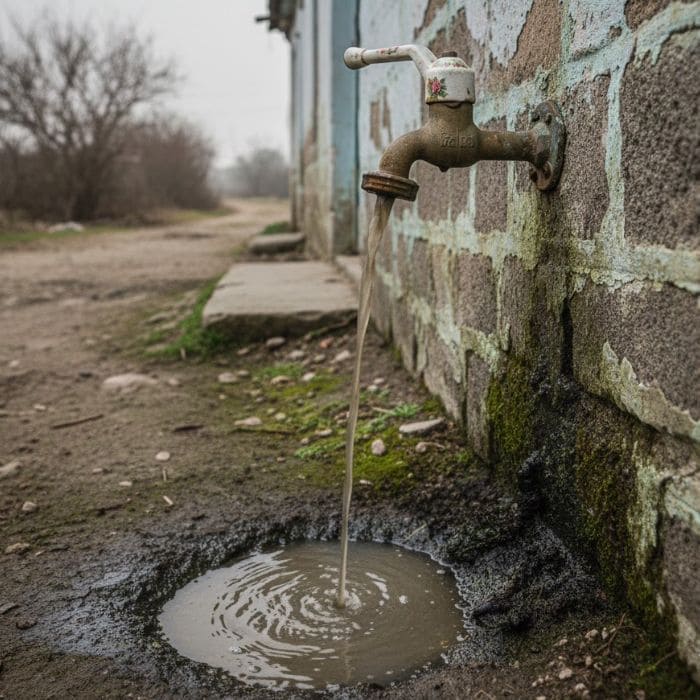
I realized that most days, I turn on the tap without a second thought, assuming safety because the system is supposed to work, and yet those systems depend on constant monitoring, maintenance, and protection.
Reading about pollution made me curious rather than panicked, curious about what actually happens between dirty water and usable water, and how much effort is involved in making that transformation.
That curiosity is what led me to think about a homemade DIY water filter, not as a solution, but as a way to understand the process more deeply.
Being Honest About What This Is and Isn’t
I want to be very clear that I have not built this filter yet, and even when I do, it will not be used to produce drinking water.
A homemade filter cannot remove bacteria, viruses, or many chemical contaminants reliably, and it should never replace professional filtration or treatment systems.
For me, this idea lives firmly in the space of learning, experimentation, and awareness, not survival or self-sufficiency.
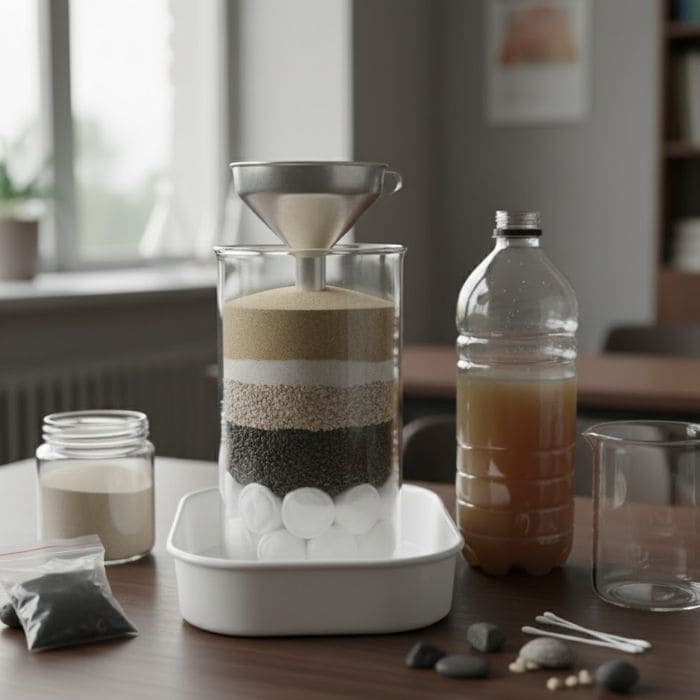
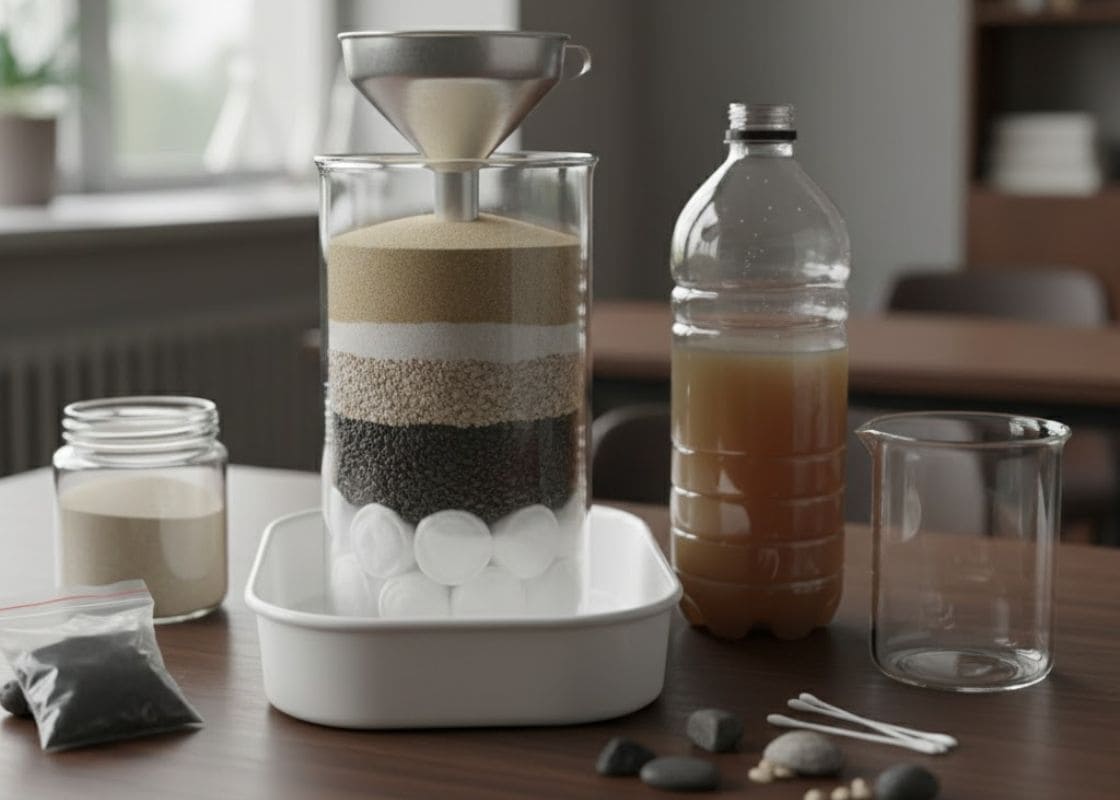
From reading educational sources and university outreach materials, I noticed that most basic filtration demonstrations rely on a few core materials, each with a specific role.
Gravel is used first to catch large debris. Sand follows, slowing water down and trapping finer particles.
Activated charcoal appears often because of its ability to absorb odors and some dissolved impurities, which is why it’s used in many commercial filters.
Plus, a cloth layer or coffee filter usually sits at the bottom to prevent fine material from escaping.
What interests me most is not gathering these materials quickly, but understanding how each layer contributes to the process and why order matters.
How the Filtration Mechanism Actually Works
A simple DIY filter works because water is forced to move slowly through layers with different physical properties, not because it is being cleaned in a complete sense.
Large particles are stopped early, finer sediment is trapped later, and charcoal interacts chemically rather than mechanically. The process depends on time, gravity, and contact, not speed.
Seeing water change as it passes through layers can make pollution feel tangible rather than abstract, which is part of why I find the idea valuable.
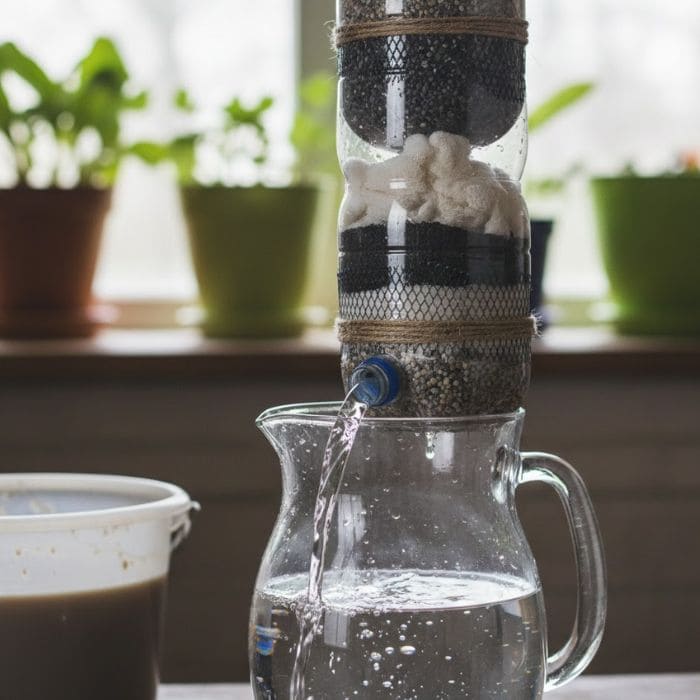
A homemade filter can make water look clearer and smell less unpleasant, and it can remove visible debris, but it cannot guarantee safety.
It does not kill pathogens, it does not remove all chemicals, and it does not meet any health standards for drinking water. I see it as a visual and educational tool, not a practical one.
That distinction matters, because misunderstanding it can be dangerous.
Why I Still Think This Idea Is Worth Exploring
Even with its limits, I think building a simple filter is worth doing, because it changes how you think about water.
Watching murky water slowly clear through layers of natural materials makes the effort behind clean water visible, and it highlights how fragile the system really is.
It also reinforces something important, which is that clean water is not automatic, it is produced through knowledge, infrastructure, and constant care.
If I go forward with this project, what I want most is understanding, understanding how filtration works at a basic level, how materials interact, and how easily water quality can be affected by what enters our environment.
I want to observe the before and after, not to trust the result, but to respect the process.