I still call myself a comic lover, even though I no longer live like one in the way I used to, because love does not always disappear all at once, sometimes it just changes shape quietly while you are busy becoming someone else.
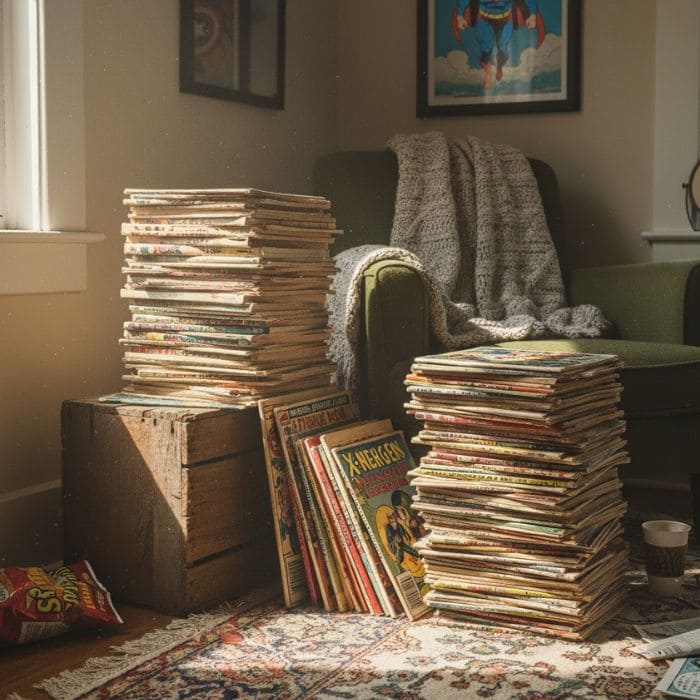
These days I read less, collect less, and spend more time making things with my hands, but in the corner of my bedroom there has been a stack of comic books that never quite left my life, leaning against the wall like something waiting patiently to be understood.
I noticed them again last week while cleaning, stacked unevenly, colors still bold, pages slightly yellowed at the edges, and I felt that familiar tension rise, the one between wanting to keep something because it holds memory and wanting to let it go because it no longer fits neatly into who you are now.
Selling them crossed my mind, of course, but the prices were low and the thought felt wrong, like trading something personal for convenience, while leaving them untouched felt just as unsatisfying.
When Reading Turns Into Seeing
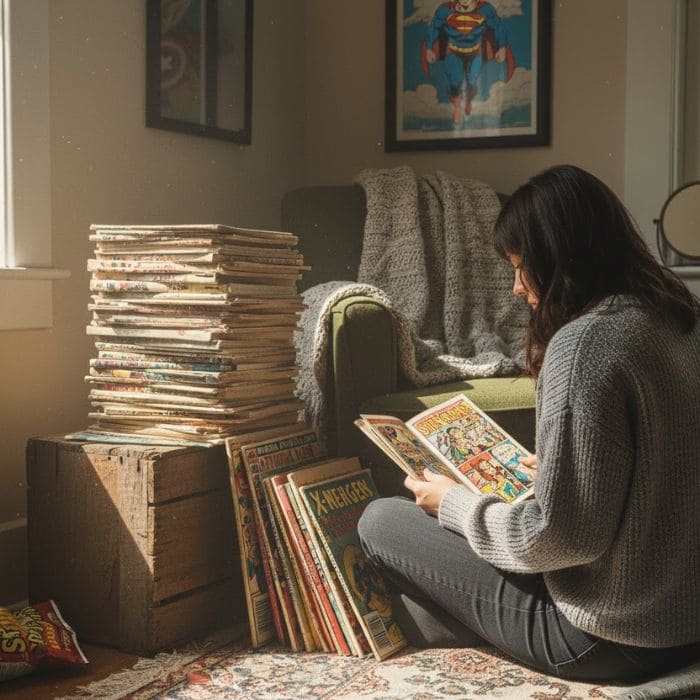
I sat on the floor and flipped through a few issues without reading them properly, letting my eyes move over panels instead of stories, and that was when I realized how much I loved the pages not for their narrative anymore, but for their color, movement, and energy.
Some pages felt almost abstract when you stopped following the dialogue, blocks of color colliding, characters frozen mid-motion, expressions exaggerated in a way that felt graphic rather than literary.
Without fully planning it, I looked up and noticed the old wooden chair near my desk, functional but tired, its surface already worn enough that failure would not feel tragic, and I wondered what would happen if those comic pages stopped being something I stored and became something I lived with.
The Chair: Where the Idea Proved Itself
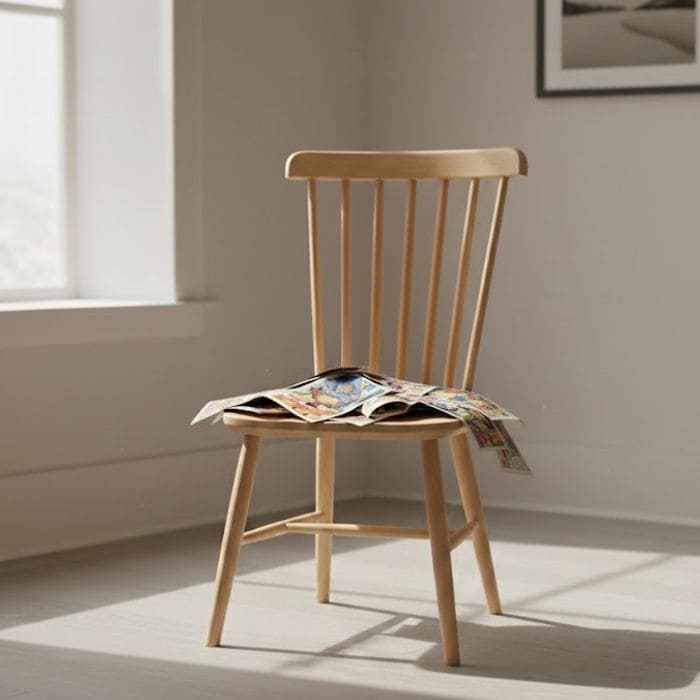
I approached the chair carefully, not because the process was difficult, but because intention matters with projects like this.
I did not tear pages randomly. I selected them slowly, especially for the seat and the front-facing parts, choosing panels that I loved visually even without context, bold colors, expressive scenes, moments that still made me smile without needing explanation.
For the chair seat, I used around 30 comic pages, overlapping them slightly to avoid visible gaps, while the backrest took another 20 pages, trimmed carefully to follow the curve of the wood.
I learned quickly that you always need more pages than expected, not for coverage, but for freedom, because adjustment is where the piece starts to feel deliberate instead of forced.
The Glue That Made or Broke the Idea
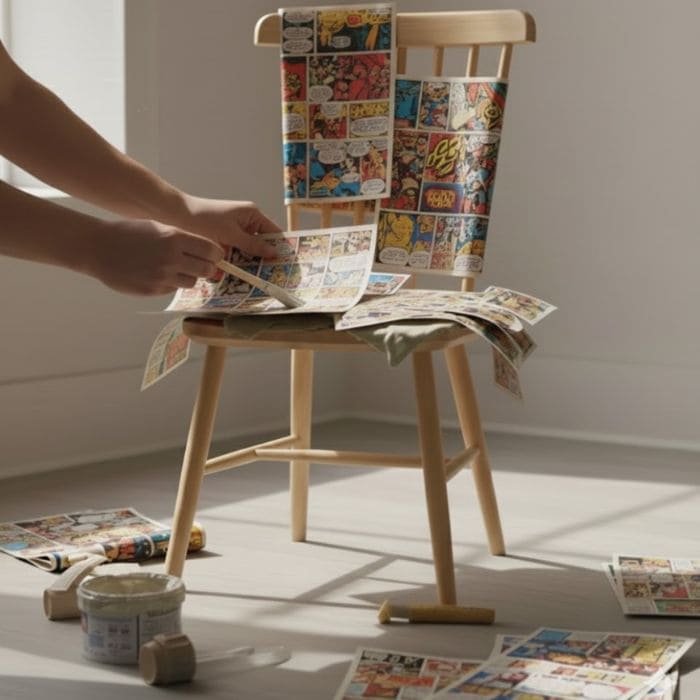
This is where honesty matters. Glue can ruin everything if you choose poorly.
I had tried thin white glue before on other paper projects, and it wrinkles too much, while spray adhesive gives you no mercy once the page touches the surface.
What worked best was a matte decoupage glue, thick enough to hold but slow enough to let me reposition pages without panic.
I applied glue directly onto the chair in small sections, never onto the paper itself, then laid each page down gently, smoothing outward with my hands, pressing just enough to release air without tearing the surface.
This part was slow, repetitive, and oddly calming, the kind of process where you forget about time and start trusting your hands.
How I Chose Which Pages Deserved the Center
One personal rule guided me through the entire project, which was to treat the most visible areas like quiet stages.
The center of the seat and the middle of the backrest were reserved for pages I genuinely loved, iconic panels, striking compositions, moments I could recognize instantly. Edges and overlaps became places for text-heavy or background scenes that blended naturally once layered.
This balance is what made the chair feel composed rather than chaotic, like a collage with intention instead of nostalgia scattered everywhere.
Once all pages were placed, I sealed the surface with two thin coats of the same decoupage glue, letting each layer dry fully before adding the next, because this is what turns paper into something you can actually sit on without fear.
When the Chair Worked Better Than I Had Hoped
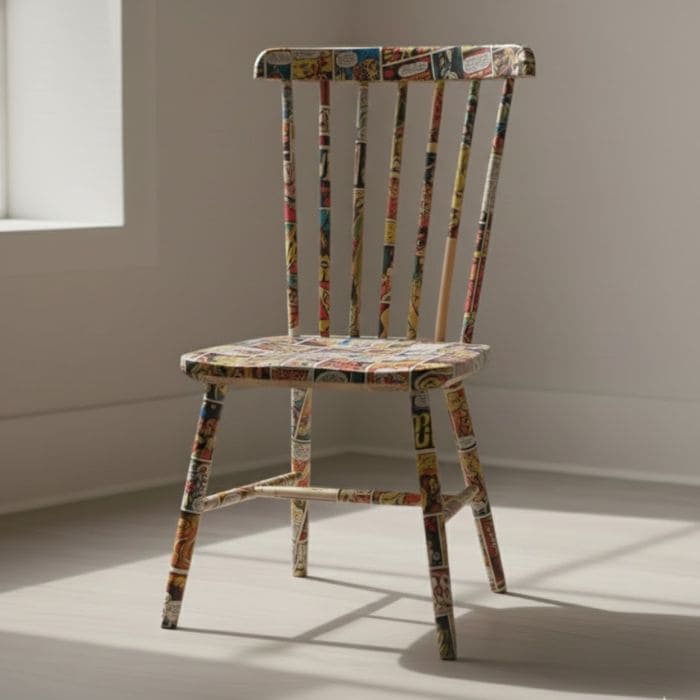
After the chair dried, I sat on it cautiously at first, then normally, and realized something important had happened, which was that it did not feel delicate or precious, it felt usable.
The surface was smooth, slightly textured, visually rich without being overwhelming, and for the first time those comics felt present rather than stored.
That success made the next step inevitable.
The Dresser: Scaling the Idea Without Losing Control
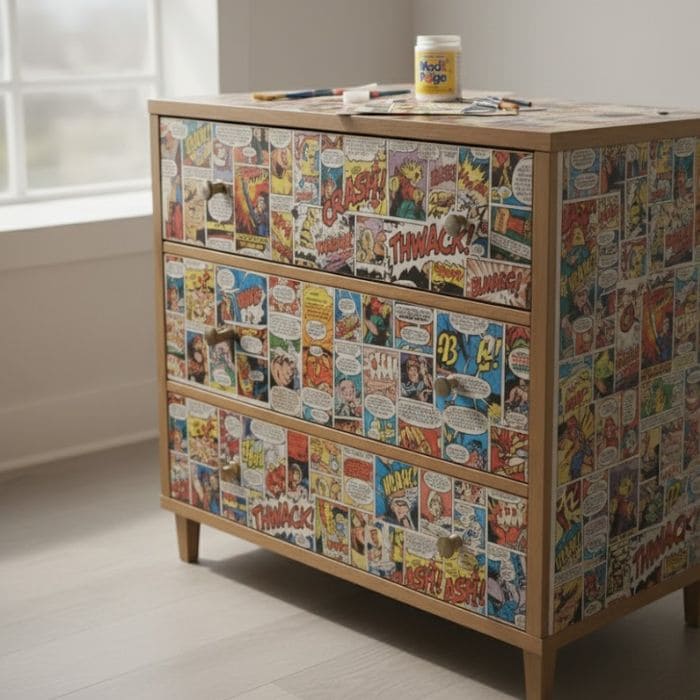
The dresser was larger, heavier, and far less forgiving, which meant I approached it differently.
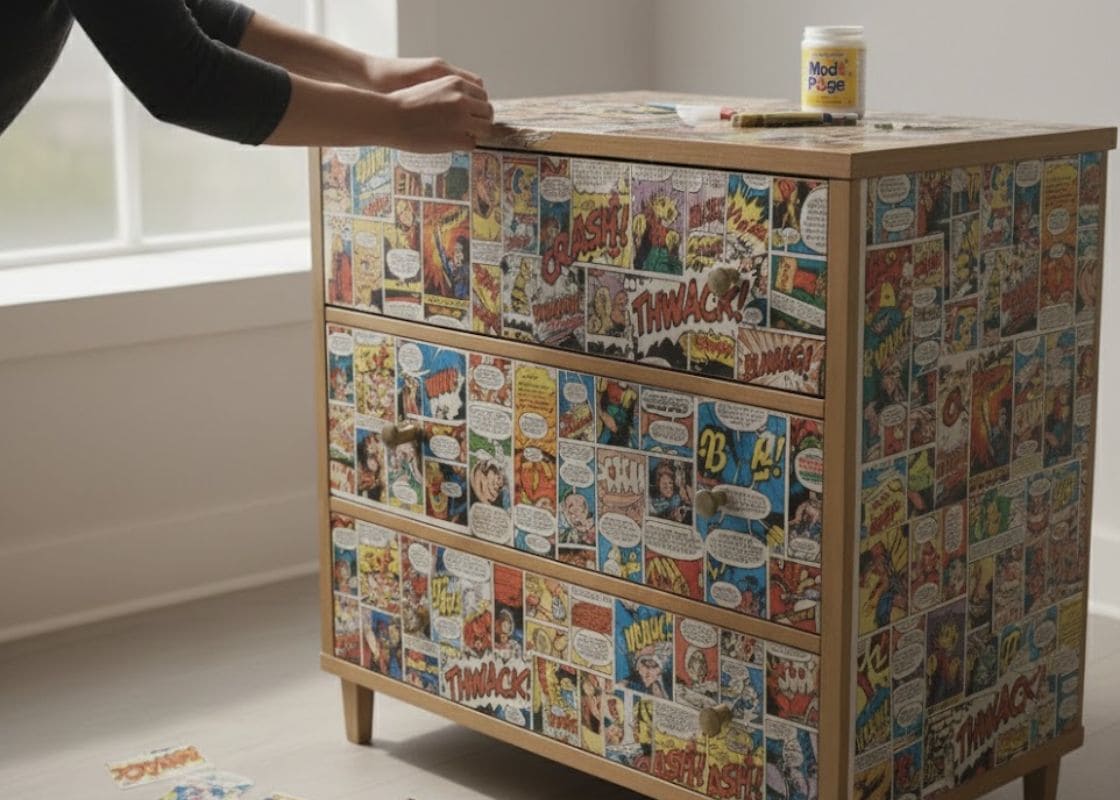
Instead of covering everything, I focused only on the drawer fronts, letting the sides remain untouched so the design would not overpower the room.
I removed each drawer and worked on them flat, one at a time, which turned out to be essential for alignment and sanity.
For the dresser, I used between 110 and 130 comic pages, depending on drawer size, and this time I laid everything out on the floor first, arranging pages to see how colors flowed across the entire piece, making sure one drawer did not visually dominate the others.
Why Slowing Down Was the Only Way This Worked
Each drawer was glued, smoothed, sealed, and left to dry completely before I moved on, because rushing larger surfaces invites disaster.
Once everything was finished, I let the dresser cure for at least 48 hours before reassembling it, and that patience is what made the result feel permanent rather than experimental.
The final piece felt bold but grounded, playful without being loud, and surprisingly cohesive considering the chaos it came from.
A Few Honest Tips If You Ever Try This
Start small. Choose pages you genuinely love for visible areas. Use a glue that gives you time. Seal patiently. Let pieces cure fully before using them.
And most importantly, do not treat this like a trend or a clever hack, because it works best when it comes from respect for the material and the memory it carries.